

It is my personal theory that everyone has had a bad wax. Mine happened when I was 23 at a European Wax Center (a place I remain loyal to, despite the trauma). The eyebrow wax was an unplanned add-on, and I still remember my wax artist pausing after the center strip took too much off of my inner brow.
Coming off of my teen years where everything bounces back, I thought my brows would grow back to their original shape and fullness in no time. And certainly within a year. But years passed, and so began my journey of intervention and restoration. Here’s what I’ve tried, ratings included:
Eyebrow Pencils (5/10)
My first move was filling in the brows with makeup. It was difficult to find a product that was precise enough – thin enough to create hair-like strokes and waxy enough to hold. I tried powders, pencils, and gels. Ultimately, two products stood the test of time. The first was the Boy Brow Pencil in Cool Brown from Glossier and the second was Precisely, My Brow Pencil from Benefit in Neutral Deep Brown. I went for cooler, deeper tones which helped transfer enough pigment when I used the pencil very lightly to create the strokes. This worked for awhile, but doing it everyday was tedious and my quality control was not great.
(The Right) Microblading (7/10)
I started researching more semi-permanent options when I was in business school. I was scared of the “block brow” look, which includes a lot of unnatural-looking shading. I was able to find a place in NorCal with extremely compelling before & afters. The strokes they apply are extremely thin, so even as the pigment settles, it still resembles a hair stroke. I went to Arches Brow in Sonoma. The founder’s instagram is here, where you can see exactly what I’m talking about.
I went for one treatment and follow-up. I was extremely happy with the outcome and contemplated going a second time, one-year out. But I wanted to be very careful with adding any more pigment that could blend in with what was residually there. I also began to wonder what happened to my actual hair and the follicle, so my next stop was the dermatologist.
Latisse (10/10)
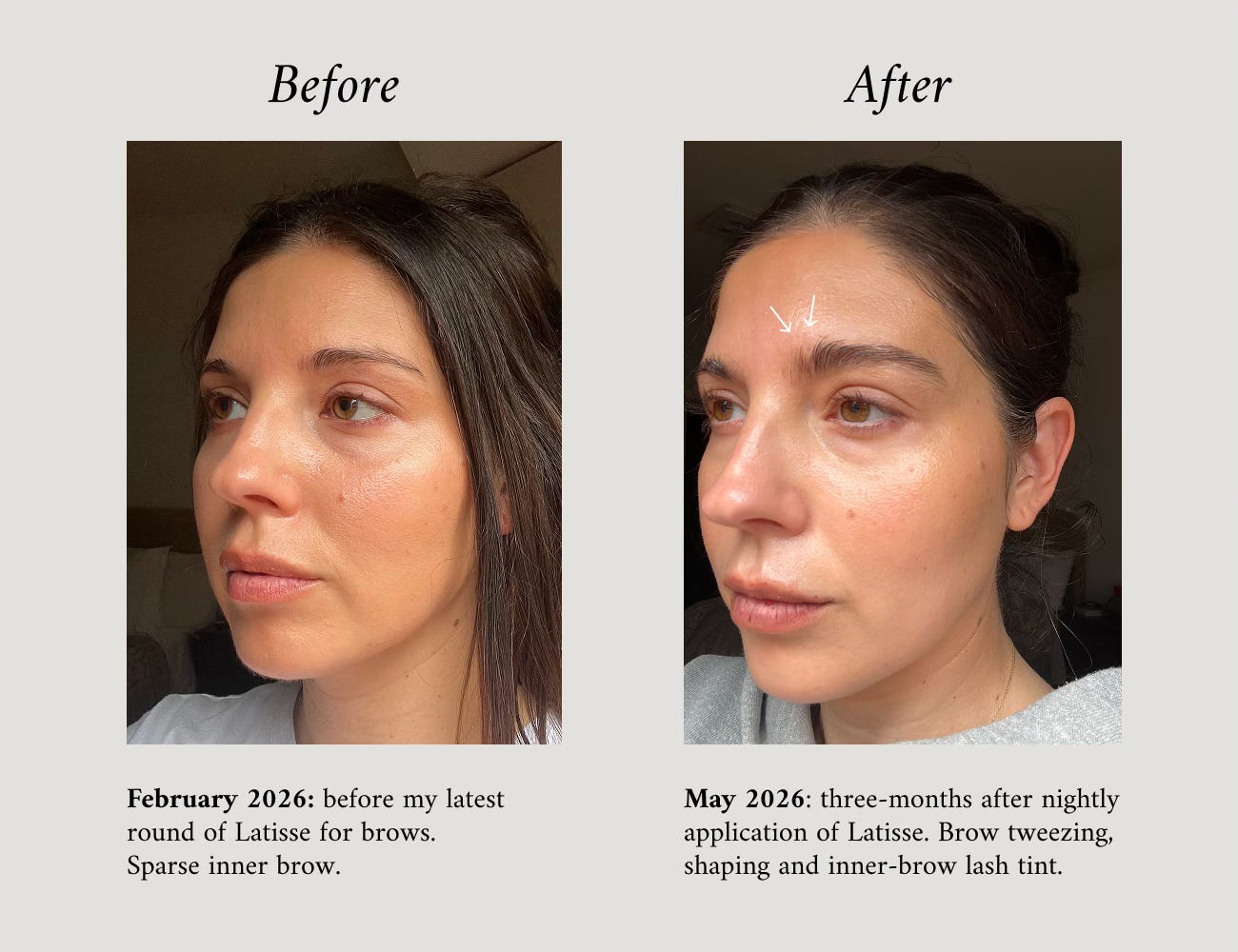
One of the best lessons I learned from my dermatologist is that Latisse can be used on the brows. It is marketed heavily as an eyelash product, but it’s actually indicated for both. It requires a consistent effort and patience (nightly application & 3 - 4 months to see the re-growth), but when the hair comes back, it is truly magical.
At first I bought the branded product (Latisse) from my dermatologist. It was around $400 for a vial that lasted 4 months. For my second round, I went through Amazon Pharmacy and ordered the generic bimatoprost, costing $30 and arriving at my door same-day. If you google “how to get Latisse,” it will almost certainly pop up as an ad.
I apply only to the inner brow every night before bed. I focus on doing this in rounds that mimic the hair growth cycle, and will keep doing this 1-2 times per year in areas that are sparse.
Brow Shaping & Tinting (8/10)
This has been the “finishing touch”. I do not do this at home and am very careful with who I trust given the history. Now I find brow artists that tweeze instead of wax because they tend to be more precise.
In New York, I go to Diana Augustoni. She has helped blend the sparser areas with the areas that are more dense. One of her tricks is using a darker lash tint in the sparser areas, making the hair look more pronounced. In SF, I have my next appointment booked at Michelle Holmes Studio. Diana actually carries Michelle’s products in her own studio and recommended the brow gel to me.
Brows are the ultimate never-ending project.